Big changes are coming to Florida wind mitigation inspections. These changes could directly affect your insurance premiums. Whether you’re a first-time homeowner or a long-time resident, this update matters to you. Maybe you recently purchased a property. Maybe it’s been a few years since your last inspection. Either way, now is the time to pay attention. Understanding what’s changing - and acting on it - could put real money back in your pocket.
What Is a Wind Mitigation Inspection — and Why Does It Matter?
A wind mitigation inspection is a specialized assessment of your home’s construction features to determine how well it can withstand hurricane-force winds. In a state like Florida — where hurricane season runs from June 1 through November 30 and windstorm insurance is one of the biggest drivers of homeowner insurance costs — this inspection is one of the most financially powerful tools available to property owners.
Under Florida Statute §627.0629, insurance companies are legally required to offer premium discounts and deductible reductions to homeowners whose properties include verified wind-resistant construction features. Those discounts can reach up to 88% off the windstorm portion of your policy — savings that, for many Central Florida homeowners, translate to hundreds or even thousands of dollars per year.
The official document used to capture and report these features is the Uniform Mitigation Verification Inspection Form, OIR-B1-1802, administered by the Florida Office of Insurance Regulation (OIR).
Major Update: The New OIR-B1-1802 Form Takes Effect April 1, 2026
Here’s the most important news for Florida homeowners right now: the OIR has proposed a significant update to the 1802 form, with the new version set to take effect April 1, 2026.
The Florida Office of Insurance Regulation has proposed an amendment to Rule 69O-170.0115 to adopt a new version of form OIR-B1-1802. The new form updates the fixtures and construction techniques that qualify for discounts, taking into account a 2024 Residential Wind-Loss Mitigation Study — which updates research conducted years ago when the mitigation discount program was still in its infancy.
What does this mean for you? The updated discount tables and qualifying criteria reflect more current building science and real-world hurricane performance data. Some features may qualify for higher discounts; others may be evaluated differently. The full impact on individual premiums is still being determined, but one thing is clear: homeowners who get ahead of this change will be best positioned to maximize their savings.
Florida Statute §627.0629 requires the OIR to review and update the fixtures or construction techniques demonstrated to reduce windstorm damage — along with the related insurance discounts and deductible reductions — by January 1, 2025, and every five years after that. The April 2026 form rollout is a direct result of that mandated review.
The 7 Key Categories Evaluated on Form OIR-B1-1802
A licensed inspector completing the 1802 form evaluates your home across seven critical areas. Understanding these categories helps you know what to expect — and what upgrades might boost your discount tier:
1. Building Code Compliance — Was your home built to Florida Building Code 2001 or later? Homes constructed in 2002 or after generally receive automatic baseline credits. Homes in Miami-Dade and Broward counties are evaluated against the South Florida Building Code (SFBC-94) for High Velocity Hurricane Zone (HVHZ) compliance.
2. Roof Covering — The type and installation method of your roofing material. Products that meet Florida Product Approval standards score higher.
3. Roof Deck Attachment — How the plywood or OSB decking is fastened to the rafters or trusses. Homes with 8d ring-shank nails on 6-inch spacing perform significantly better in windstorm events.
4. Roof-to-Wall Connection — The weakest connection point between your roof and your walls is assessed. Single wraps, double wraps, clips, and structural anchors each correspond to different credit tiers.
5. Roof Shape — Hip roofs (sloped on all four sides) are the most wind-resistant design and typically earn the largest discounts. Gable roofs receive lower credits due to their increased vulnerability to wind uplift.
6. Secondary Water Resistance (SWR) — A self-adhering membrane applied beneath the roof covering that prevents water intrusion if shingles are blown off. This feature is increasingly important to insurers after recent hurricane seasons.
The Uniform Mitigation Verification Inspection Form (OIR-B1-1802) is valid for up to five years, provided no material changes are made to the structure or inaccuracies are found on the form.
This five-year clock matters. If your report is approaching expiration — or if you’ve had roof work, new windows, or other structural upgrades — it’s time to schedule a fresh inspection. With the new form taking effect April 1, 2026, renewing your inspection now (under the current form) or after the transition (under the updated form) will be an important strategic decision to discuss with your inspector and insurance agent.
Who Qualifies to Perform a Wind Mitigation Inspection in Florida?
Not just anyone can complete a legally valid 1802 form. Under Florida Statute §627.711, qualified inspectors include:
Licensed home inspectors (under §468.8314) who have completed at least 3 hours of OIR-approved hurricane mitigation training and passed a proficiency exam
Licensed general, building, or residential contractors
Licensed professional engineers or architects
Certified building code inspectors
Citizens Property Insurance reserves the right to verify any wind mitigation form completed by a qualified inspector by ordering an independent inspection, and will not accept forms where the inspector’s Florida license is not active or cannot be verified. This is why choosing a reputable, licensed inspection company matters — an invalid or improperly completed form could cost you your discounts entirely.
Free Inspections and Matching Grants: My Safe Florida Home Program
If you haven’t upgraded your home’s wind-resistant features because of cost concerns, there’s good news. In 2025, Florida expanded the My Safe Florida Home program with $280 million in new funding to help families afford wind mitigation upgrades, offering free inspections and matching grants for improvements like impact windows, doors, and roof upgrades.
This program provides a two-step pathway: first, receive a free wind mitigation inspection, then apply for a matching grant to fund qualifying home hardening improvements. Visit MySafeFLHome.com to check eligibility and availability.
Don’t Wait — Schedule Your Inspection Before the April 2026 Form Change
With the updated OIR-B1-1802 form set to take effect April 1, 2026, Central Florida homeowners have a narrow window to act strategically. Whether your goal is to lock in current discount tiers, document recent upgrades, or simply get ahead of the changes before hurricane season, a wind mitigation inspection is one of the highest-ROI steps you can take as a homeowner.
At Central Florida Building Inspectors (CFBI), our licensed inspectors are certified in wind mitigation assessments and stay current on all OIR form requirements and Florida Building Code updates. We serve homeowners throughout the greater Central Florida area with thorough, photo-documented 1802 inspections that insurers trust.
Not every home issue leaves a visible mark. Moisture can spread behind walls, insulation can be missing in key areas, and electrical components can overheat long before damage shows on the surface. A thermal imaging camera helps inspectors detect these hidden conditions by identifying temperature differences that would otherwise go unnoticed.
In Central Florida, where heat, humidity, and heavy rain are part of everyday life, thermal imaging can add meaningful insight to a home inspection.
When used correctly, it helps inspectors spot patterns that may point to moisture intrusion, insulation gaps, air leakage, or electrical concerns.
This article explains what a thermal imaging camera can reveal during a home inspection, how inspectors interpret what they see, and what buyers, sellers, and homeowners should realistically expect from this technology.
What Thermal Imaging Actually Shows During an Inspection
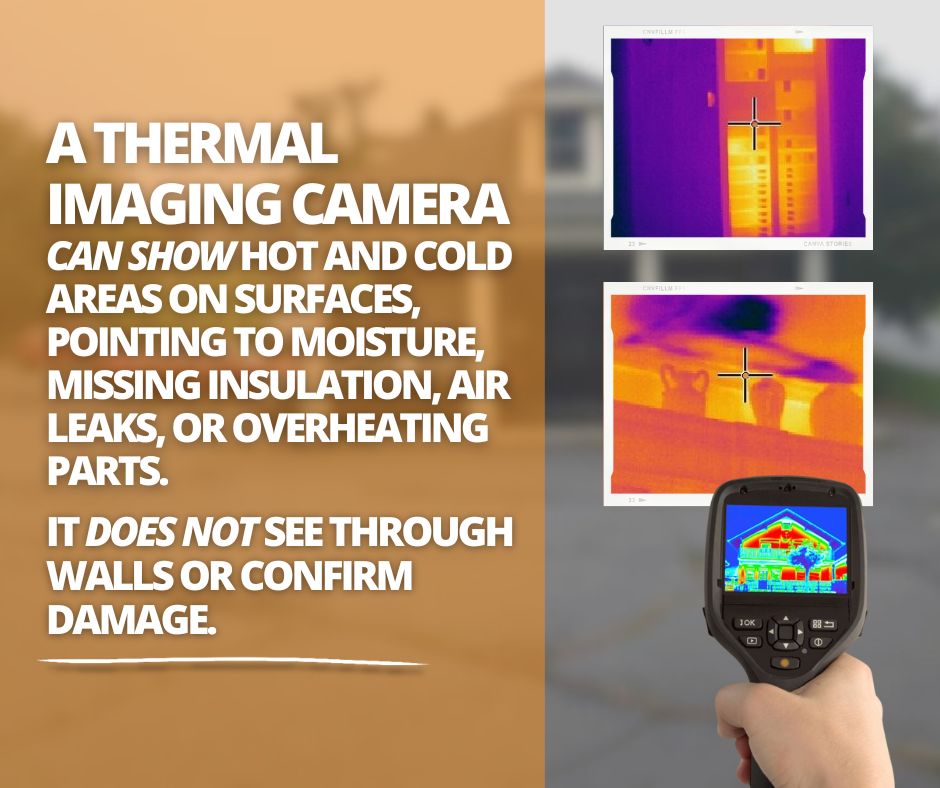
A thermal imaging camera does not see through walls or materials. Instead, it detects differences in surface temperature and displays them visually. These temperature variations can indicate that something behind the surface is behaving differently than expected.
During an inspection, the camera highlights warmer and cooler areas across walls, ceilings, floors, and system components. These patterns help inspectors identify areas that deserve closer attention.
Thermal imaging is best understood as a tool for pattern recognition, not diagnosis. It helps answer the question, “Does this area behave differently than it should?” From there, inspectors use experience, context, and visual confirmation to determine whether the pattern is significant.
Why Thermal Imaging Is Especially Valuable in Central Florida Homes
Central Florida homes face conditions that make hidden issues more likely to develop.
High humidity increases the risk of moisture intrusion and condensation inside walls and ceilings. Frequent rain events can allow water to enter through small openings around roofs, windows, or exterior walls without leaving immediate stains.
Warm temperatures can also mask moisture problems until damage progresses.
Thermal imaging helps inspectors identify temperature patterns that may suggest moisture presence, insulation gaps, or air leakage before visible damage appears. In a climate where moisture-related problems are common, this additional layer of insight can be especially valuable.
Moisture Patterns Thermal Imaging Can Help Identify
One of the most common uses of thermal imaging during inspections is identifying areas that may be affected by moisture.
Moisture changes the temperature of building materials. Wet areas often appear cooler than surrounding surfaces due to evaporation. These cooler patterns can help inspectors locate areas where water intrusion may be occurring.
Thermal imaging may highlight moisture-related concerns near:
Windows and doors
Roof penetrations and ceiling areas
Plumbing fixtures and supply lines
Exterior walls exposed to wind-driven rain
In Florida, early moisture detection matters. Prolonged moisture exposure can contribute to mold growth, material deterioration, and indoor air quality concerns.
While thermal imaging does not confirm the source of moisture, it helps inspectors identify where further evaluation may be needed.
Insulation and Energy Performance Clues
Thermal imaging can also reveal how well a home’s insulation is performing.
Missing, compressed, or uneven insulation often creates temperature inconsistencies that show up clearly on a thermal image. During an inspection, these patterns may indicate areas where heat is entering or escaping more easily than expected.
Common insulation-related findings include uneven attic coverage, wall sections with reduced insulation, or areas where insulation has shifted over time. In Central Florida, poor insulation performance can increase cooling costs and make it harder to control indoor humidity.
Thermal imaging does not measure insulation levels directly, but it helps identify areas where insulation may not be doing its job effectively.
Air Leakage and Comfort Issues
Air leakage is another issue thermal imaging can help reveal.
When conditioned air escapes or outside air enters the home, temperature differences often appear around windows, doors, attic access points, and wall penetrations. These patterns can help explain comfort complaints, uneven room temperatures, or higher energy bills.
In hot, humid climates like Central Florida, air leakage can also affect moisture control. Warm, humid air entering the home places additional strain on cooling systems and can contribute to condensation problems.
Thermal imaging helps inspectors visualize these patterns so homeowners can better understand where improvements may be beneficial.
Electrical Concerns That May Show Up on Thermal Imaging
Thermal imaging can assist inspectors in identifying potential electrical safety concerns.
Overheating electrical components often appear as localized hot spots on a thermal image. These temperature differences may suggest loose connections, overloaded circuits, or failing components.
Inspectors commonly use thermal imaging to scan areas such as electrical panels, breakers, and major connections. When abnormal heat patterns are observed, inspectors document the finding and recommend further evaluation by a licensed electrician.
Thermal imaging does not diagnose electrical problems, but it can help flag conditions that should not be ignored.
What Thermal Imaging Can and Cannot Tell You
Thermal imaging is a powerful inspection tool, but it has clear limitations.
It can help identify:
Temperature differences that suggest moisture presence
Understanding these limits helps set realistic expectations and prevents overreliance on the technology.
How Inspectors Interpret Thermal Images
Thermal images are not evaluated in isolation. Inspectors interpret them in context.
Factors such as weather conditions, recent system use, building materials, and visible conditions all influence how thermal patterns are read. A cooler area on a wall, for example, may indicate moisture, missing insulation, or air movement. The inspector’s role is to evaluate which explanation is most likely based on the full inspection.
When a thermal anomaly is identified, inspectors document the finding and explain what it may indicate. They also explain what additional steps may be appropriate to confirm the issue.
What Thermal Imaging Findings Mean for Buyers and Sellers
For buyers, thermal imaging can provide additional insight into potential hidden issues before purchasing a home. Findings may support requests for further evaluation, repairs, or credits during negotiations.
For sellers, thermal imaging can help identify concerns before listing. Addressing moisture intrusion, insulation gaps, or electrical issues ahead of time can reduce surprises during the inspection process and help transactions move more smoothly.
Related Questions Homeowners Ask
Does thermal imaging always find hidden water damage? No. Thermal imaging helps identify temperature patterns that may suggest moisture, but it cannot confirm the source or extent of water damage on its own. If a suspicious pattern is found, further evaluation is usually needed to confirm what is causing it.
Can a thermal imaging camera see mold inside walls? Thermal imaging cannot see mold directly. It may highlight temperature differences caused by moisture conditions that can support mold growth, which helps inspectors identify areas that may need closer attention.
Does every home inspection include thermal imaging? Not always. Thermal imaging is an added inspection tool and may be offered as part of enhanced inspection services. Homeowners should confirm whether thermal imaging is included or available as an option.
When to Call a Professional
Thermal imaging helps identify unusual temperature patterns, but it does not provide final answers on its own.
A home inspection with thermal imaging added on is the right step when you want an overall evaluation of the home and professional insight into what thermal patterns may indicate. Inspectors use thermal imaging to document areas that behave differently than expected and explain whether those findings suggest moisture, insulation gaps, air leakage, or electrical concerns that may need closer attention.
If inspection findings or ongoing conditions raise concerns about mold, a mold professional should be consulted next. Mold specialists can perform targeted testing to determine whether mold is present and assess the extent of any contamination. This type of testing goes beyond the scope of a standard home inspection.
Central Florida Building Inspectors uses thermal imaging to help guide informed decisions, and Elite Mold Services provides specialized mold evaluation when confirmation is needed.
Conclusion
A thermal imaging camera can reveal important clues about a home that are not visible during a standard walk-through. In Central Florida, where moisture, heat, and humidity create unique challenges, this technology can add valuable insight during a home inspection.
When used responsibly, thermal imaging helps inspectors identify areas that deserve closer attention while setting clear expectations about what the technology can and cannot do.
Combined with a professional home inspection, it provides homeowners with a clearer understanding of a home’s condition and potential risks.
Radon is an invisible, odorless gas that can enter a home without any obvious warning. Many Central Florida homeowners do not realize the signs are there until a radon test reveals its presence.
While radon is more common in certain parts of the country, pockets of elevated levels exist throughout Florida. This means every home has the potential for radon exposure, no matter its age, style, or location.
Because radon cannot be seen, smelled, or tasted, the signs are not always clear. Still, there are patterns and conditions that increase risk. This guide explains the most common signs that your home may have elevated radon levels, what homeowners should watch for, and when it is time to schedule radon testing.
Why Radon Testing Matters in Central Florida
Many homeowners assume Florida is not a radon-prone state, but this is not true. According to the Florida Department of Health, one in five Florida homes tested shows elevated radon levels. This includes homes with slab foundations, crawlspaces, and even newer construction.
Central Florida’s soil and geology allow radon to collect under homes, especially in areas with:
Sandy soil
Deep foundations
Poor ventilation under the slab
Cracks or gaps around plumbing or utilities
High humidity keeps air movement low
Because radon has no smell or taste, the only way to confirm levels is through testing. Recognizing the conditions that increase risk helps homeowners decide when to act.
The Most Common Signs of Radon Exposure in a Home
Radon itself does not create visible stains or odors. Instead, signs appear through a combination of building conditions, indoor air quality complaints, and the home’s foundation or soil contact.
Here are the most important indicators to watch for.
1. Air That Feels Stale or Heavy in Lower Levels
Radon collects in the lowest part of a home because it enters through the soil. In Central Florida, many homes built on slabs still have areas where air becomes stagnant.
can indicate poor air circulation, which increases the chance that radon is accumulating.
Radon rises naturally, but homes with closed-up windows, long cooling seasons, and limited airflow can trap more of it inside.
2. Cracks in the Foundation or Slab
Cracks in concrete slabs or block walls create easy pathways for soil gases. These cracks do not cause radon, but they make it easier for radon to enter.
Common entry points include:
Hairline cracks across the slab
Cracks in block walls
Gaps around pipes
Openings around sump wells or utility penetrations
Florida’s soil shifts during rainy and dry seasons. As the ground expands and contracts, new cracks can form, giving radon more pathways inside.
3. High Humidity Levels That Make the Home Feel Damp
Radon enters from the soil, and Florida’s climate keeps moisture levels high. When a home feels damp for long periods, it often means the air is not moving well. Poor circulation allows radon to collect in the lowest parts of the home.
High humidity does not prove radon is present, but it often appears in homes with elevated levels because of:
Long cooling seasons
Reduced ventilation
Slab contact with moist soil
Indoor air that stays trapped for long periods
The EPA notes that radon levels can rise in homes that are sealed tightly or cooled for long periods without fresh airflow.
4. Lingering Odors or Stuffy Rooms
While radon itself has no smell, rooms with poor airflow often develop odors that linger. If certain rooms always feel stuffy or take a long time to air out, it may indicate that the air is not moving well enough to prevent radon from building up.
Stuffy rooms do not confirm radon, but they signal airflow problems that increase risk.
5. Soil Contact Around the Home That Looks Damp All Year
Damp or wet soil around the exterior of a home can increase the chance that radon collects below the slab. Central Florida’s rainy seasons, sprinkler systems, and high groundwater all contribute to saturated soil.
Wet soil does not cause radon, but it allows gases to stay trapped close to the foundation, making it easier for radon to seep inside.
6. Long Periods With Windows Closed
Florida’s heat, storms, and humidity mean many homeowners keep windows closed almost all year. When indoor air does not circulate, radon has fewer ways to escape.
Energy-efficient homes are great for comfort and cooling costs, but they often allow radon levels to rise more easily without regular testing.
At a Glance: Conditions That Increase Radon Risk
Condition
Why It Matters
What Homeowners Notice
Foundation cracks
Creates radon entry points
Small gaps, hairline cracks
High humidity
Reduces airflow
Rooms feel damp or sticky
Poor ventilation
Traps radon indoors
Stuffy or still air
Long cooling seasons
Home stays sealed
Hard to introduce fresh air
Damp soil around the home
Holds gases near the slab
Moist areas or pooling water
Why Is Radon a Health Concern?
Radon is the second leading cause of lung cancer in the United States, according to the EPA.
Long-term exposure increases risk because radon particles can be inhaled into the lungs.
Children may be more sensitive to radon because their breathing rates are higher relative to their body size.
The health effects of radon come from long-term exposure, not short-term contact. This is why regular testing is important, especially during the times of year when windows stay closed, and air is less likely to move freely.
How Do Radon Levels Change Throughout the Year?
Radon levels can rise or fall depending on several seasonal factors. Many Central Florida homes experience changes due to:
Rainy seasons and storm moisture
High water tables
Temperature swings
HVAC usage patterns
Soil pressure changes
The EPA also notes that radon levels often spike during cooler months when homes stay closed. In Central Florida, similar increases can happen during hot summer months when air conditioners run all day.
How Does Radon Enter a Home?
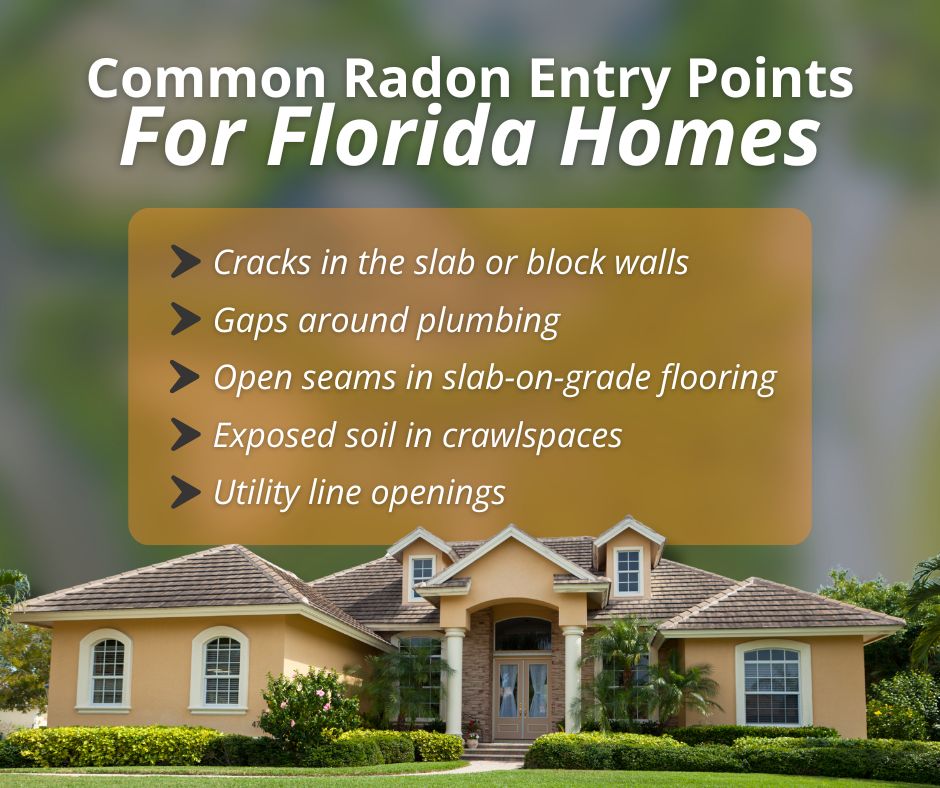
Radon moves from the soil into homes through the path of least resistance. Common entry points include:
Foundation cracks
Open block walls
Gaps around plumbing or electrical
Sump pump openings
Crawlspaces or low-lying areas
Once inside, radon becomes trapped without proper ventilation. Because radon is a gas, it can move through even very small gaps.
What Homeowners Should Do if These Signs Are Present
If you notice any conditions on this list, the next step is simple: schedule a radon test. Testing is the only way to confirm the presence or level of radon inside a home.
Homeowners should consider testing when:
Buying or selling a home
Moving into a home built on a slab
Renovating or opening sealed areas
Living in a home with little airflow
Noticing persistent humidity or moisture issues
It has been more than two years since the last test
Radon testing is fast, affordable, and one of the most helpful steps homeowners can take to ensure a safe indoor environment.
Other Related Questions
Do Florida homes with slabs still need radon testing? Yes. Even homes without basements can have elevated radon levels because the gas moves directly through the soil and slab.
Can radon get into newer energy-efficient homes? Yes. Tighter construction often traps indoor air for longer periods, which can allow radon to accumulate more easily.
Is radon only a concern in older homes? No. Radon can affect homes of any age, and newer homes can sometimes experience higher levels due to improved air sealing.
Should I test for radon before buying a home in Central Florida? Many buyers do. Radon testing provides peace of mind and helps you understand the indoor air quality before closing.
When to Call a Professional
Call a qualified inspector when you want accurate testing and clear results. Testing is recommended when:
Buying or selling a home
Noticing poor airflow or humidity issues
Living in a home with slab-on-grade construction
It has been two or more years since the last test
You want to confirm the current indoor air quality
You live in an area known for elevated radon levels
Professionals use accurate testing equipment and provide clear results, so you know whether additional steps are needed to make the home safer.
Conclusion
Radon is a silent indoor air quality concern that can affect any home in Central Florida. While the signs are not always obvious, certain conditions and patterns make elevated radon levels more likely. Recognizing these risk factors and scheduling a radon test can help protect your home and your family.
If you want a clear understanding of radon levels in your home, Central Florida Building Inspectors can help. Book a visit today to get accurate results and take the next step toward a safer indoor environment.