Let’s make sure you know what a Phase 1 site assessment actually is, what it covers, and who needs to get one before moving forward on a commercial deal in Central Florida.
If you’re buying commercial property, you’ve probably heard the term Phase 1 site assessment come up during due diligence. For some buyers, it feels like just another box to check. In reality, it’s one of the more important steps in the entire transaction, and skipping it or rushing it can create serious problems down the road.
Explaining Phase 1 Site Assessments
A Phase 1 Environmental Site Assessment, or Phase 1 ESA, is a records-based and observational review of a property’s environmental history.
It doesn’t involve any drilling, digging, or physical testing. The goal is to identify whether there’s any reason to believe the property has been contaminated, or is at risk of contamination, based on its history and current conditions.
The specific thing the assessment looks for is called a Recognized Environmental Condition, or REC. A REC is any indication that hazardous substances or petroleum products may have been released on the site, or that conditions exist that could create environmental liability for the new owner.
Phase 1 assessments follow the ASTM standard E1527-21. At CFBI, assessments meet that standard and can be tailored to fit the specific needs of each transaction.
What the Process Actually Looks Like
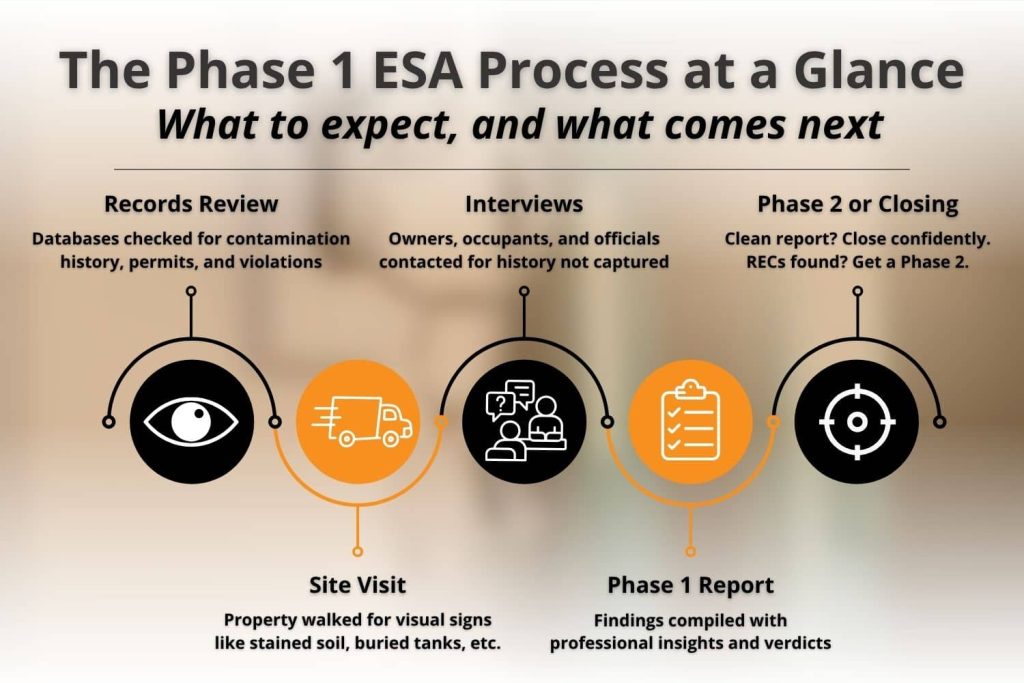
A Phase 1 has four main components. Together, they build a full picture of the property’s environmental background.
Records Review
The assessor pulls federal, state, and local regulatory databases to look for anything tied to the property or nearby sites.
EPA records, Florida DEP files, underground storage tank registrations, cleanup histories, permits, and violations all get reviewed. This step establishes the documented history of the land before anyone ever sets foot on it.
Site Visit
The assessor physically walks the property and looks for visual signs of contamination.
Stained soil, stressed or dead vegetation, unusual odors, abandoned drums or containers, vent pipes that suggest buried tanks, and evidence of chemical use or dumping all get noted. What you can see on the ground sometimes tells a story that records don’t.
Interviews
Key property stakeholders, like current and past owners, occupants, and local officials, get interviewed when they’re available.
These conversations often surface information that never made it into any database, particularly on older properties with multiple prior tenants or uses.
Report
Everything gets compiled into a written report: a site description, regulatory findings, site visit observations, interview notes, and a professional opinion on whether RECs are present. If the assessor identifies RECs, the report will typically recommend a Phase 2 ESA to investigate further.
(Visual idea: Canva process graphic showing the four Phase 1 components as a simple horizontal flow: Records Review, Site Visit, Interviews, Report)
Who Needs One?
Most commercial property buyers need a Phase 1, and most lenders require one. Here’s a more specific look at who should be getting this done:
| Buyer or Party | Why a Phase 1 Is Needed |
|---|---|
| Commercial property buyers | Due diligence before purchase |
| Real estate investors | Risk assessment and liability protection |
| Developers and land buyers | Required before permitting or financing |
| SBA loan applicants | Required by SBA for most commercial loans |
| Lenders and banks | Required before approving commercial financing |
| Long-term commercial tenants | Protection against inherited liability |
One thing worth understanding: environmental liability can attach to a new owner even if they had nothing to do with the contamination. That’s not a hypothetical. It happens.
A Phase 1 is one of the primary tools that helps establish the innocent landowner defense under federal law. Without it, you have very little legal ground to stand on if contamination turns up after you’ve already closed.
Why Do Lenders Require It?
If you’re financing a commercial purchase through a conventional lender or an SBA loan, a Phase 1 ESA is almost always a requirement before closing. The lender needs to know the asset they’re securing a loan against doesn’t carry hidden environmental liability that could tank its value.
This applies broadly across property types: office buildings, retail centers, industrial sites, and mixed-use properties can all trigger the requirement depending on the lender’s guidelines. Getting the Phase 1 ordered early in due diligence keeps it from becoming a bottleneck when you’re trying to close.
What a Phase 1 Can and Can’t Tell You
Phase 1 is a powerful tool, but it has real limits. Knowing both sides of that helps set the right expectations going in.
A Phase 1 can:
- Identify recognized environmental conditions based on records and visual observation
- Flag prior land uses that may have left contamination behind
- Satisfy most lenders and SBA requirements
- Support the innocent landowner defense under CERCLA
- Recommend whether a Phase 2 investigation is warranted
A Phase 1 cannot:
- Confirm or rule out contamination with certainty
- Test soil, groundwater, or building materials
- Evaluate conditions that are invisible and undocumented
- Address mold, radon, indoor air quality, or other building-specific concerns
If Phase 1 raises red flags, Phase 2 is the next step. That’s where soil and groundwater sampling happens and where lab results either confirm a problem or give you a cleaner picture to work with.
CFBI specializes in Phase 1 assessments and does not perform Phase 2 investigations directly, but if your report surfaces concerns that warrant further testing, the team can point you toward qualified environmental contractors who do.
(Visual idea: Simple Canva map graphic highlighting CFBI’s service area from Tampa to Daytona with key counties labeled)
Phase 1 vs. Phase 2 vs. Property Condition Assessment
These three terms come up together often in commercial due diligence. They’re related but cover very different ground:
| Assessment Type | What It Covers | Physical Testing? |
|---|---|---|
| Phase 1 ESA | Environmental history and visual conditions | No |
| Phase 2 ESA | Soil, groundwater, and material sampling | Yes |
| Property Condition Assessment | Building structure and systems | No |
A Property Condition Assessment looks at the physical condition of the building itself. A Phase 1 looks at the environmental history of the land it sits on.
They answer different questions, and for many transactions, both get completed as part of a thorough due diligence process.
Florida’s Added Layer of Complexity
Central Florida’s land use history makes Phase 1 work here more involved than in some other markets. The region has grown fast, and that growth has converted agricultural land, former gas stations, dry cleaners, auto shops, and light industrial sites into commercial and residential developments at a rapid pace. Many of those prior uses involved materials that linger in soil and groundwater.
The Florida DEP maintains active cleanup records and regulatory databases that factor directly into Phase 1 reviews. Properties with former citrus grove history may carry pesticide concerns.
Older commercial corridors in Orange, Osceola, Seminole, Volusia, and Hillsborough Counties tend to have layered use histories that require careful review. This is not an area where a quick records pull and a drive-by site visit is going to cut it.
Related Questions to Explore
What other inspections are typically part of commercial due diligence in Florida? Beyond the Phase 1 and a standard commercial inspection, buyers often add mold inspection and testing, radon testing, sewer scope inspections, and termite inspections, depending on the property type and age. Properties with pools, solar panels, or balconies and railings may warrant additional specialty evaluations as well.
Is a 4-point inspection required for commercial properties in Florida? A 4-point inspection is primarily a residential insurance requirement in Florida, covering the roof, electrical, plumbing, and HVAC systems. Commercial properties follow different insurance and lender inspection requirements, which is part of why a formal property condition assessment or Phase 1 ESA is the more relevant starting point for commercial buyers.
What should buyers know about wind mitigation in Central Florida? Wind mitigation inspections document construction features that reduce a building’s vulnerability to storm damage. In Florida, where hurricane season is a real planning factor, these inspections can directly affect insurance premiums. They’re more common on residential properties but relevant for certain commercial buildings as well.
How does a pre-purchase inspection differ from a property condition assessment? A pre-purchase inspection is typically a buyer-initiated evaluation of a property’s overall condition before closing. A property condition assessment is a more formal, standardized report often required by lenders that follows ASTM protocols and includes cost estimates for major repairs. The scope and documentation requirements are meaningfully different.
When to Call a Professional
Get Phase 1 on the calendar early, not at the end of due diligence when you’re already under pressure to close. These are the situations where reaching out to CFBI right away makes the most sense:
- You’re purchasing any type of commercial property: Retail, office, industrial, warehouse, or vacant land. Environmental liability doesn’t sort by property type.
- Your lender or SBA loan requires it: Order it at the start of due diligence, not when the lender asks for it mid-process.
- The property has a history of industrial, agricultural, or automotive use: These are the highest-risk categories for environmental contamination in Florida.
- You’re buying land for development: Permitting and construction financing almost always require a clean Phase 1 on file before work starts.
- The site is near a gas station, dry cleaner, or industrial operation: Contamination travels. What’s happening next door matters.
Conclusion
A Phase 1 site assessment gives you documented evidence of a property’s environmental history before you’re legally attached to it. In a market like Central Florida, where rapid development has layered decades of varied land use onto sites across the region, that documentation matters more than most buyers expect until they actually need it.
CFBI has been working with commercial buyers, investors, and developers across Central Florida since 1988. Whether you need a Phase 1 ESA, a full property condition assessment, or both as part of a complete due diligence package, their team is ready to help you move forward with a clear picture of what you’re getting into. Schedule your assessment today.