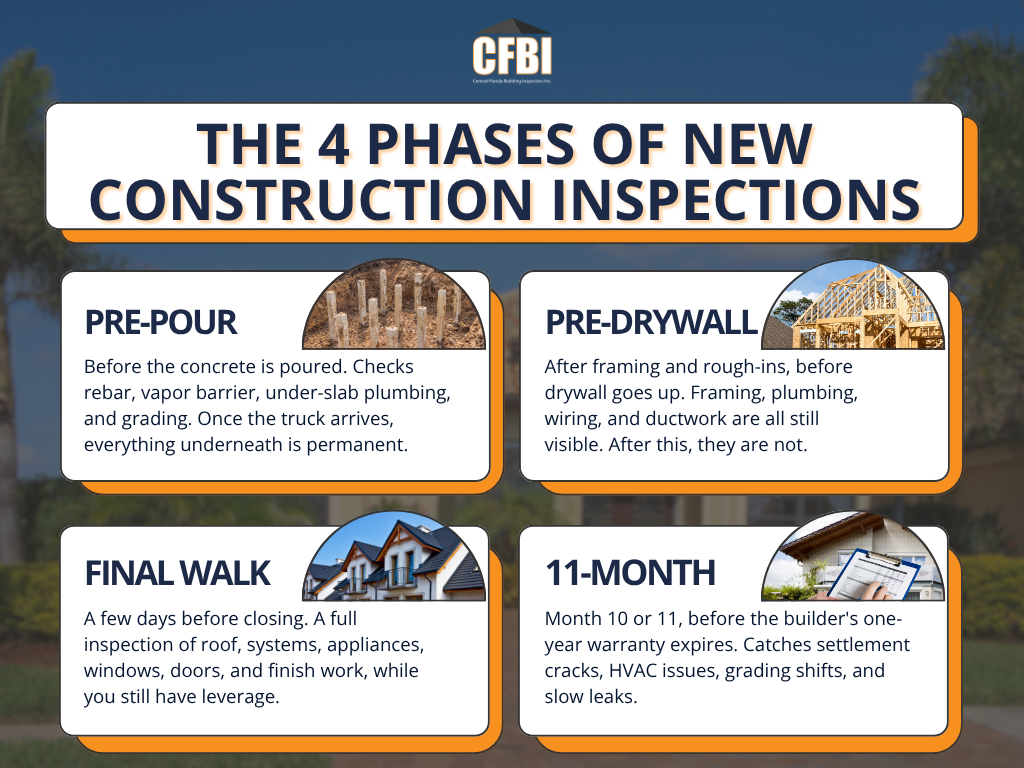
New construction inspections happen in four phases: before the concrete is poured, after framing but before drywall, just before closing, and again near the end of the builder’s one-year warranty. Each phase looks at work the next one covers up for good.
That is the part most buyers miss. A brand-new house is not a finished product you evaluate once. It is a sequence, and the things worth catching are only visible for a few days at a time.
Central Florida Building Inspectors has been inspecting Florida builds since 1988, and the phase people skip most often is the one they tend to regret.
The Four Phases at a Glance
The phases follow the build rather than the calendar, so exact timing depends on your builder’s schedule. What stays consistent is the order and the reason each one exists.
| Phase | When | What It Catches |
|---|---|---|
| Pre-pour foundation | 1 to 2 days before the slab is poured | Rebar placement, vapor barrier, under-slab plumbing, grading |
| Pre-drywall | After framing and rough-ins, before drywall | Cut joists, missing straps, flashing, duct and wiring defects |
| Final walkthrough | Days before closing | Roof, systems, appliances, windows, doors, finish work |
| 11-month warranty | Month 10 or 11 | Settlement cracks, HVAC underperformance, grading, slow leaks |
Any phase can be booked on its own, and plenty of buyers pick just one or two. Booking all four buys visibility into work that is about to disappear behind concrete, insulation, and paint.
What Happens in Each Phase Inspection?
These are not four versions of the same inspection. Each phase exists because a specific set of components is exposed at that moment and will not be exposed again.
Here is what each one covers and why the timing is so important.
Pre-Pour Foundation
This phase has the shortest window in the entire build. Once the concrete truck arrives, everything underneath becomes permanent.
An inspector checks rebar placement and spacing, the vapor barrier, under-slab plumbing, anchor placement, and the formwork against the plans. Termite pretreatment gets verified here as well.
Soil and grading carry more weight in Florida than national guidance suggests. Central Florida’s sandy soil and high water table behave nothing like the compacted clay most construction advice assumes, and a slab poured over poorly prepared ground settles unevenly for years.
Builders in this market are usually pouring on a tight schedule, so this is the one phase where a single phone call from you can change the outcome. A misplaced run of rebar takes an hour to correct before the pour and tens of thousands to address afterward.
Slab problems are expensive mainly because of what has to come off to reach them. That is a fair preview of what happens when a foundation starts to settle. The full scope is on our pre-pour foundation inspections page.
Pre-Drywall
For most buyers, this is the highest-value phase. Framing, plumbing, electrical, and HVAC are all installed and still completely visible.
That combination is what makes it worth scheduling. Common findings include:
- Joists cut or notched to make room for a pipe
- Missing hurricane straps and fasteners
- Window flashing installed out of sequence
- Ducts crushed, kinked, or disconnected
- Wiring run where it does not belong
None of that can be seen again once drywall goes up, short of cutting holes in a finished wall. InterNACHI’s pre-drywall inspection overview walks through the scope, and ours sits on the pre-drywall inspections page.
Final Walkthrough
A few days before closing, the house gets a full inspection to the same standard as any resale property: roof, exterior, attic, structure, plumbing, electrical, HVAC, appliances, and finishes.
This is a different thing from the builder’s walkthrough. That one is an orientation, where somebody shows you how the thermostat works and writes a punch list on a clipboard.
Yours produces a written report with photographs, delivered while you still have leverage and money has not yet changed hands.
Grading and drainage belong on the list too. A new lot is still settling, downspouts are easy to aim wrong, and water needs somewhere to go from the first storm onward.
Finish defects matter here as well, even the small ones. Scratched glass, a door that does not latch, tile set unevenly, and paint over unsanded drywall are all far easier to get corrected before closing than after.
11-Month Warranty
Most Central Florida builders offer a one-year workmanship warranty. This inspection lands at month 10 or 11, which leaves time to actually file before it closes.
A year of heat, rain, and settling brings out what was invisible at closing. Hairline cracks appear. An HVAC system that seemed fine in March cannot keep up in August. Grading shifts and a slow leak finally stain a ceiling.
The report is what converts all of that into a specific, photographed request your builder can act on. Waiting until month 13 means the window has already shut.
Why Code Inspections Are Not the Same Thing
Nearly every buyer raises the same objection, and it deserves a straight answer: the county already inspected this house, so why pay for another one?
The two inspections answer different questions.
| County Code Inspection | Private Inspection |
|---|---|
| Works for the jurisdiction | Works for you |
| Pass or fail against minimum code | Judges workmanship above the code floor |
| Minutes per visit | Full walkthrough of the phase |
| No report issued to you | Written report with photographs |
| Confirms legality | Confirms quality |
Florida’s licensing agency draws the same line, describing building inspectors as ensuring code compliance while home inspectors give a written professional opinion of the home’s condition.
There is also a wrinkle specific to Florida worth knowing. State law lets a builder hire its own licensed private provider to handle code inspections instead of the building department.
Those inspections are legitimate, and they satisfy the permit. The inspector is simply working for the builder, not for you.
None of this means code inspections are worthless. It means “it already passed inspection” answers a question about legality when what you asked about was quality.
Related Questions to Explore
Do phase inspections replace city or county inspections? No. They run alongside them and answer a different question, so one never substitutes for the other.
Can a builder refuse to let an inspector in? Some try. Access is much easier to secure when it is written into the purchase contract before you sign, so raise it with your agent early rather than negotiating at framing.
Are new construction inspections mandatory? No. They are optional and buyer-paid, which is exactly why so many new homes are never independently inspected at all.
How much do new construction inspections cost? It depends on the phase, the size of the home, and whether you book phases separately or as a package. Call for current pricing in your area.
What happens if the inspection finds something? You hand your builder a written report with photographs. Documented items get fixed, while vague complaints get scheduled and forgotten.
Should I get an inspection if the builder has a good reputation? Yes, and good builders rarely object. A reputable builder would rather fix something at the framing stage than get a warranty call in year two.
Is a new home really likely to have problems? Every house is built by people working on a deadline. The detail matters right down to whether a circuit is sized for what is plugged into it, and that is the kind of thing a report catches.
When to Call a Professional
Timing is the whole game here, because every phase closes on its own schedule and none of them wait for you.
- Pre-pour: as soon as forms and rebar are set. This window lasts a day or two.
- Pre-drywall: the moment rough-ins are finished, before the insulation crew arrives.
- Final: a few days ahead of closing, so there is room to get items addressed.
- 11-month: put it on the calendar the day you close.
That last one is worth a reminder in your phone. Nobody from the builder is going to call and tell you the warranty is about to expire.
Central Florida Building Inspectors has inspected new construction across Orlando, Tampa, Ocala, Lakeland, Winter Garden, and Lake Nona since 1988. Our state-licensed inspectors work for you rather than the builder, and the report belongs to you.
Conclusion
A new house is not a guarantee of good work. It is a guarantee that any mistakes are brand new, documented, and still somebody else’s responsibility to fix. Three things worth carrying forward:
- Four phases, each looking at work the next one covers up. Pre-drywall is the one buyers regret skipping.
- A county code inspection confirms the house is legal. It says nothing about how well it was built.
- The 11-month inspection has a deadline attached. Put it on the calendar at closing.
None of this requires you to distrust your builder. It just puts a second set of eyes on the parts of the house you will never see again.
If you have a build underway or a closing on the horizon, schedule an inspection or read more about our new home construction inspections.