The signs you need a foundation inspection are the ones that change: a crack that widens, a door that starts sticking, a floor that begins to slope. Most Florida homes have cracks somewhere, and most of them mean nothing.
Central Florida Building Inspectors has been reading that difference on Florida slabs since 1988. Here’s what to look for inside and outside your home, what causes movement in this part of the state, and when it’s worth a call.
What Movement Looks Like Inside
Foundation movement shows up indoors first. The house is a rigid box sitting on soil that isn’t, so when part of a slab settles, the tightest-fitting parts of the house complain first.
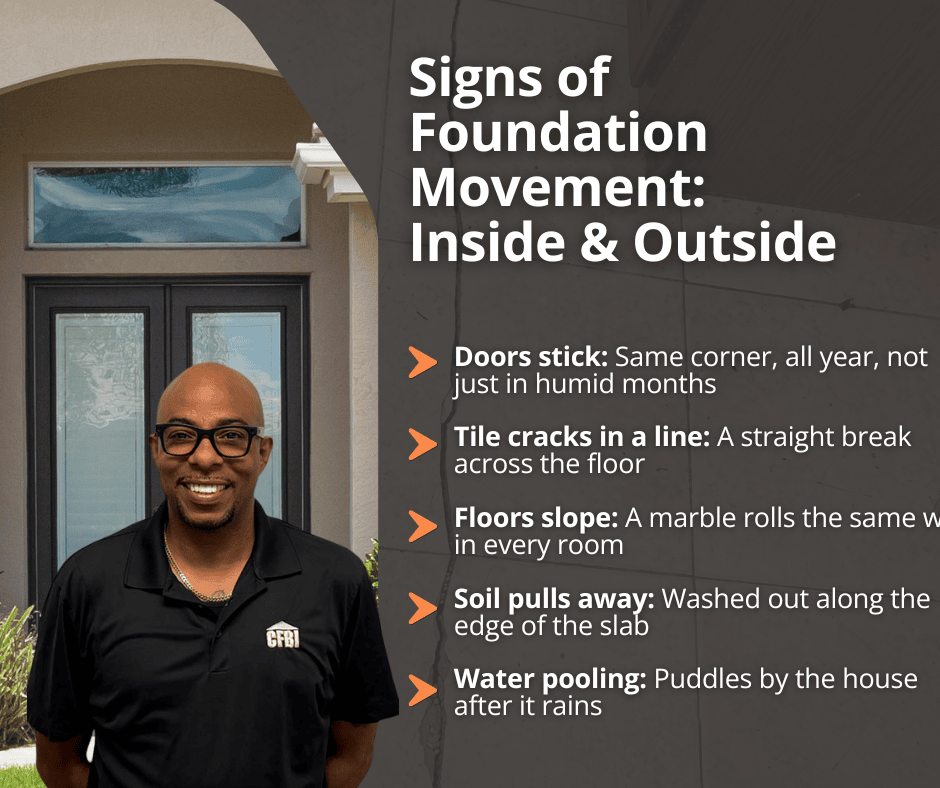
Doors are the earliest warning. A door that binds at one top corner, or one that used to latch and now needs a shove, means the frame is out of square. Humidity swells wood too, so the test is whether it ever releases. Seasonal swelling eases in the dry months. Foundation movement sticks year-round.
Floors come next. A single low spot in one room is a construction issue. A floor that pitches the same direction in every room is differential settlement. In slab homes, a line of cracked tile across a room is often the first thing anyone notices, because tile breaks along the crack underneath it before drywall shows anything.
Then the finish work separates. Cabinets are anchored to wall framing, so when the slab drops, the countertop pulls away and leaves a gap. Crown molding lifting off the ceiling and rows of popped nail heads are the same signal in different materials.
Quick Indoor Check, 5 Min
- Roll a marble in three or four rooms and note which way it goes
- Open and close every exterior door, plus the windows you rarely use
- Run a finger along cabinet and countertop joints
- Look for tile cracks that run in a straight line
Where the Problem Actually Starts
Indoors gives you symptoms. The perimeter gives you the cause, and in Central Florida the cause is almost always water. Walk the house during the next heavy rain, not on a dry afternoon. That’s when drainage problems are obvious.
Look for:
| What You See Outside | Why It Matters |
|---|---|
| Soil washed away from the slab edge | Erosion is creating a void under the foundation |
| Downspouts emptying at a corner of the house | Concentrated water saturates one spot repeatedly |
| Mulch or grading sloped toward the house | Water is being directed at the foundation |
| Standing water lasting more than a day | Poor drainage, sustained soil saturation |
| Large trees close to the house | Roots draw moisture out of soil during dry spells |
One more worth watching: a water bill that jumps with no change in usage. A failed line under the slab washes out soil just as effectively as a bad downspout.
Plumbing symptoms elsewhere point the same direction, and a bubbling toilet can signal a drainage problem underground worth ruling out first.
Why Florida Foundations Fail Differently
Most foundation advice online was written for somewhere else. It assumes a basement, clay soil, and freeze-thaw cycles, and almost none of it applies here.
| Elsewhere | Central Florida |
|---|---|
| Basements and crawl spaces | Slab-on-grade, so symptoms show in tile, doors, and cabinets |
| Expansive clay that swells and shrinks | Sandy soil that erodes and washes out |
| Stable bedrock | Limestone that groundwater dissolves over time |
| Seasonal freeze | Months of rain, then dry season, then rain again |
The limestone is why Florida sees more sinkhole activity than any other state. USGS notes that limestone dissolution is responsible for virtually all sinkholes in Florida.
Homes built on former wetland or poorly compacted fill also keep settling for years after construction, and that history rarely shows up in a listing.
Settlement or Sinkhole?
Most Florida foundation movement is ordinary settlement. The two look nothing alike once you know what separates them.
| Settlement | Sinkhole Activity |
|---|---|
| Develops over years | Appears over days |
| Concentrated at one corner or addition | Affects the yard and structure together |
| Tracks with visible drainage problems | Circular depression, ground drops suddenly |
| Yard looks normal | Fence posts or pool deck tilt as a unit |
Worth knowing: a home inspector does not confirm a sinkhole. Florida’s Department of Environmental Protection states that home inspectors and insurance adjusters are not qualified to make that determination, and that only a licensed geologist or engineer can. Our job is to identify the signs, document them, and tell you when to escalate.
The Florida Geological Survey’s sinkhole FAQ covers what the state recommends.
Cosmetic or Structural?
Direction and pattern do most of the work here. Vertical hairline cracking that holds steady is normal. Diagonal, stair-step, and horizontal cracks are the ones that suggest movement.
| What You See | Usually Means | What to Do |
|---|---|---|
| Hairline, stable | Normal curing | Monitor |
| Vertical, under 1/8 inch, not growing | Common settlement | Monitor, seal if water enters |
| Diagonal from a door or window corner | Frame racking | Schedule an inspection |
| Stair-step through block joints | Differential settlement | Schedule an inspection |
| Horizontal in a stem wall | Lateral pressure | Call promptly |
| Wider than 1/4 inch, or growing | Active movement | Call promptly |
The quarter-inch figure is a rule of thumb, not a diagnosis. A narrow crack that’s growing matters more than a wide one that hasn’t moved in a decade.
The 60-Day Test
This settles the question and costs nothing:
- Mark both ends of the crack with a pencil. Write the date beside it.
- Photograph it with a coin or tape measure in frame for scale.
- Note which doors stick.
- Check again in 60 days.
Past the pencil marks means active movement. No change means you have documentation, which is worth having when you sell.
What an Inspection Covers, and What It Doesn’t
A foundation inspection looks at the visible structure and the conditions acting on it:
- Slab, stem wall, or piers
- Floor level and door operation
- Exterior grading and drainage
- Moisture readings and thermal imaging where useful
- Evidence of prior repair work, which matters if you’re buying
You get a written report with photos. If the findings point to structural failure, that report is what a structural engineer builds on.
The gap that catches people out: a 4-point inspection does not include your foundation. It covers the roof, electrical, plumbing, and HVAC for insurance. Here’s what a 4-point inspection actually includes if you’re unsure which one you had.
Related Questions to Explore
How much does a foundation inspection cost? It depends on home size, foundation type, and whether you need a general inspection or a structural engineer’s report. The inspector’s evaluation is the cheaper first step and usually settles whether an engineer is needed at all.
How often should I have my foundation inspected? Every few years for most Florida homes, plus any time new symptoms appear. Move it up after a hurricane, a flood, a plumbing leak, or construction nearby. Timing it well makes a real difference in repair cost.
Who should you hire for a foundation inspection? Start with a licensed, independent home inspector who has no stake in the repair. A structural engineer comes next if there’s evidence of structural failure. Be cautious with free inspections from repair companies, since they profit from finding a problem.
How can you tell if a crack is structural? Direction, pattern, and change. Diagonal cracks from corners, stair-step cracks, and horizontal cracks suggest movement. Vertical hairline cracks at a steady width usually don’t.
Does homeowners insurance cover foundation crack repair? Usually not for settlement or gradual deterioration, which most policies exclude. Florida policies must include catastrophic ground collapse coverage, and broader sinkhole coverage is separate. It depends on your policy and the cause of loss.
Should I be worried about buying a house with foundation cracks? Not automatically. Plenty of sound Florida homes have cosmetic cracking. Get a clear read on whether the movement is active during your pre-purchase home inspection, not after closing. If repairs are needed, knowing the repair options when a foundation starts to sink helps you negotiate.
When to Call a Professional
Monitoring on your own works for stable hairline cracks. Call an inspector when:
- A crack has measurably widened over a few months
- Cracks run diagonally from corners or step through block joints
- A door that used to latch no longer does
- Floors slope consistently from room to room
- Gaps have opened between cabinets and walls
- Water pools against the foundation after every rain
- A depression appears in the yard
- You’re under contract on a home showing any of the above
Central Florida Building Inspectors has inspected homes across Orange, Lake, Sumter, Marion, Volusia, Polk, Hillsborough, Brevard, and Seminole counties since 1988. Our state-licensed inspectors will tell you what’s cosmetic and what isn’t, including when nothing needs fixing.
Conclusion
- Change is the signal, not crack width. Mark it, date it, check in 60 days.
- Florida foundations fail through water and erosion, not clay. Fix drainage first.
- A 4-point inspection doesn’t cover your foundation, and an inspector doesn’t confirm a sinkhole.
If something has shifted and you can’t tell whether it matters, have it looked at before another rainy season works on it. Schedule an inspection or browse our residential property inspection services.