Let’s make sure you know what a Phase 1 site assessment actually is, what it covers, and who needs to get one before moving forward on a commercial deal in Central Florida.
If you’re buying commercial property, you’ve probably heard the term Phase 1 site assessment come up during due diligence. For some buyers, it feels like just another box to check. In reality, it’s one of the more important steps in the entire transaction, and skipping it or rushing it can create serious problems down the road.
It doesn’t involve any drilling, digging, or physical testing. The goal is to identify whether there’s any reason to believe the property has been contaminated, or is at risk of contamination, based on its history and current conditions.
The specific thing the assessment looks for is called a Recognized Environmental Condition, or REC. A REC is any indication that hazardous substances or petroleum products may have been released on the site, or that conditions exist that could create environmental liability for the new owner.
Phase 1 assessments follow the ASTM standard E1527-21. At CFBI, assessments meet that standard and can be tailored to fit the specific needs of each transaction.
What the Process Actually Looks Like
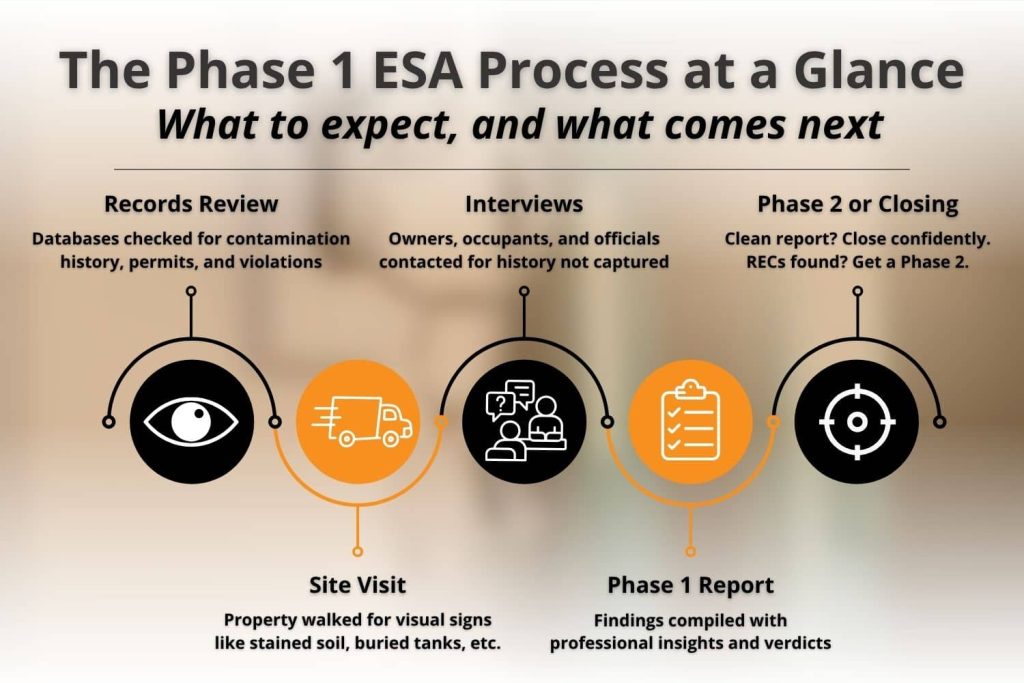
A Phase 1 has four main components. Together, they build a full picture of the property’s environmental background.
Records Review
The assessor pulls federal, state, and local regulatory databases to look for anything tied to the property or nearby sites.
EPA records, Florida DEP files, underground storage tank registrations, cleanup histories, permits, and violations all get reviewed. This step establishes the documented history of the land before anyone ever sets foot on it.
Site Visit
The assessor physically walks the property and looks for visual signs of contamination.
Stained soil, stressed or dead vegetation, unusual odors, abandoned drums or containers, vent pipes that suggest buried tanks, and evidence of chemical use or dumping all get noted. What you can see on the ground sometimes tells a story that records don’t.
Interviews
Key property stakeholders, like current and past owners, occupants, and local officials, get interviewed when they’re available.
These conversations often surface information that never made it into any database, particularly on older properties with multiple prior tenants or uses.
Report
Everything gets compiled into a written report: a site description, regulatory findings, site visit observations, interview notes, and a professional opinion on whether RECs are present. If the assessor identifies RECs, the report will typically recommend a Phase 2 ESA to investigate further.
(Visual idea: Canva process graphic showing the four Phase 1 components as a simple horizontal flow: Records Review, Site Visit, Interviews, Report)
Who Needs One?
Most commercial property buyers need a Phase 1, and most lenders require one. Here’s a more specific look at who should be getting this done:
Buyer or Party
Why a Phase 1 Is Needed
Commercial property buyers
Due diligence before purchase
Real estate investors
Risk assessment and liability protection
Developers and land buyers
Required before permitting or financing
SBA loan applicants
Required by SBA for most commercial loans
Lenders and banks
Required before approving commercial financing
Long-term commercial tenants
Protection against inherited liability
One thing worth understanding:environmental liability can attach to a new owner even if they had nothing to do with the contamination. That’s not a hypothetical. It happens.
A Phase 1 is one of the primary tools that helps establish the innocent landowner defense under federal law. Without it, you have very little legal ground to stand on if contamination turns up after you’ve already closed.
Why Do Lenders Require It?
If you’re financing a commercial purchase through a conventional lender or an SBA loan, a Phase 1 ESA is almost always a requirement before closing. The lender needs to know the asset they’re securing a loan against doesn’t carry hidden environmental liability that could tank its value.
This applies broadly across property types: office buildings, retail centers, industrial sites, and mixed-use properties can all trigger the requirement depending on the lender’s guidelines. Getting the Phase 1 ordered early in due diligence keeps it from becoming a bottleneck when you’re trying to close.
What a Phase 1 Can and Can’t Tell You
Phase 1 is a powerful tool, but it has real limits. Knowing both sides of that helps set the right expectations going in.
A Phase 1 can:
Identify recognized environmental conditions based on records and visual observation
Flag prior land uses that may have left contamination behind
Satisfy most lenders and SBA requirements
Support the innocent landowner defense under CERCLA
Recommend whether a Phase 2 investigation is warranted
Evaluate conditions that are invisible and undocumented
Address mold, radon, indoor air quality, or other building-specific concerns
If Phase 1 raises red flags, Phase 2 is the next step. That’s where soil and groundwater sampling happens and where lab results either confirm a problem or give you a cleaner picture to work with.
CFBI specializes in Phase 1 assessments and does not perform Phase 2 investigations directly, but if your report surfaces concerns that warrant further testing, the team can point you toward qualified environmental contractors who do.
(Visual idea: Simple Canva map graphic highlighting CFBI’s service area from Tampa to Daytona with key counties labeled)
Phase 1 vs. Phase 2 vs. Property Condition Assessment
These three terms come up together often in commercial due diligence. They’re related but cover very different ground:
Assessment Type
What It Covers
Physical Testing?
Phase 1 ESA
Environmental history and visual conditions
No
Phase 2 ESA
Soil, groundwater, and material sampling
Yes
Property Condition Assessment
Building structure and systems
No
A Property Condition Assessment looks at the physical condition of the building itself. A Phase 1 looks at the environmental history of the land it sits on.
They answer different questions, and for many transactions, both get completed as part of a thorough due diligence process.
Florida’s Added Layer of Complexity
Central Florida’s land use history makes Phase 1 work here more involved than in some other markets. The region has grown fast, and that growth has converted agricultural land, former gas stations, dry cleaners, auto shops, and light industrial sites into commercial and residential developments at a rapid pace. Many of those prior uses involved materials that linger in soil and groundwater.
The Florida DEP maintains active cleanup records and regulatory databases that factor directly into Phase 1 reviews. Properties with former citrus grove history may carry pesticide concerns.
Older commercial corridors in Orange, Osceola, Seminole, Volusia, and Hillsborough Counties tend to have layered use histories that require careful review. This is not an area where a quick records pull and a drive-by site visit is going to cut it.
Related Questions to Explore
What other inspections are typically part of commercial due diligence in Florida? Beyond the Phase 1 and a standard commercial inspection, buyers often add mold inspection and testing, radon testing, sewer scope inspections, and termite inspections, depending on the property type and age. Properties with pools, solar panels, or balconies and railings may warrant additional specialty evaluations as well.
Is a 4-point inspection required for commercial properties in Florida? A 4-point inspection is primarily a residential insurance requirement in Florida, covering the roof, electrical, plumbing, and HVAC systems. Commercial properties follow different insurance and lender inspection requirements, which is part of why a formal property condition assessment or Phase 1 ESA is the more relevant starting point for commercial buyers.
What should buyers know about wind mitigation in Central Florida?Wind mitigation inspections document construction features that reduce a building’s vulnerability to storm damage. In Florida, where hurricane season is a real planning factor, these inspections can directly affect insurance premiums. They’re more common on residential properties but relevant for certain commercial buildings as well.
How does a pre-purchase inspection differ from a property condition assessment? A pre-purchase inspection is typically a buyer-initiated evaluation of a property’s overall condition before closing. A property condition assessment is a more formal, standardized report often required by lenders that follows ASTM protocols and includes cost estimates for major repairs. The scope and documentation requirements are meaningfully different.
When to Call a Professional
Get Phase 1 on the calendarearly, not at the end of due diligence when you’re already under pressure to close. These are the situations where reaching out to CFBI right away makes the most sense:
You’re purchasing any type of commercial property: Retail, office, industrial, warehouse, or vacant land. Environmental liability doesn’t sort by property type.
Your lender or SBA loan requires it: Order it at the start of due diligence, not when the lender asks for it mid-process.
The property has a history of industrial, agricultural, or automotive use: These are the highest-risk categories for environmental contamination in Florida.
You’re buying land for development: Permitting and construction financing almost always require a clean Phase 1 on file before work starts.
The site is near a gas station, dry cleaner, or industrial operation: Contamination travels. What’s happening next door matters.
Conclusion
A Phase 1 site assessment gives you documented evidence of a property’s environmental history before you’re legally attached to it. In a market like Central Florida, where rapid development has layered decades of varied land use onto sites across the region, that documentation matters more than most buyers expect until they actually need it.
CFBI has been working with commercial buyers, investors, and developers across Central Florida since 1988. Whether you need a Phase 1 ESA, a full property condition assessment, or both as part of a complete due diligence package, their team is ready to help you move forward with a clear picture of what you’re getting into. Schedule your assessment today.
A commercial building inspection covers a lot more ground than a residential one: hence the need for a checklist, even as the investor. The buildings are larger, the systems are more complex, and the stakes for buyers, investors, and tenants are significantly higher.
Knowing what gets evaluated and how to prepare for the process can make a real difference in how smoothly things go and how useful the final report turns out to be.
This guide covers what a commercial inspection looks at, what clients can do to prepare, and what to expect from the report.
What Does a Commercial Building Inspection Cover?
A commercial inspection is a comprehensive evaluation of the property’s physical condition.
At CFBI, that means examining every major system and structural component, inside and out, using certified inspectors with commercial-specific training. Let’s go over what a thorough inspection addresses.
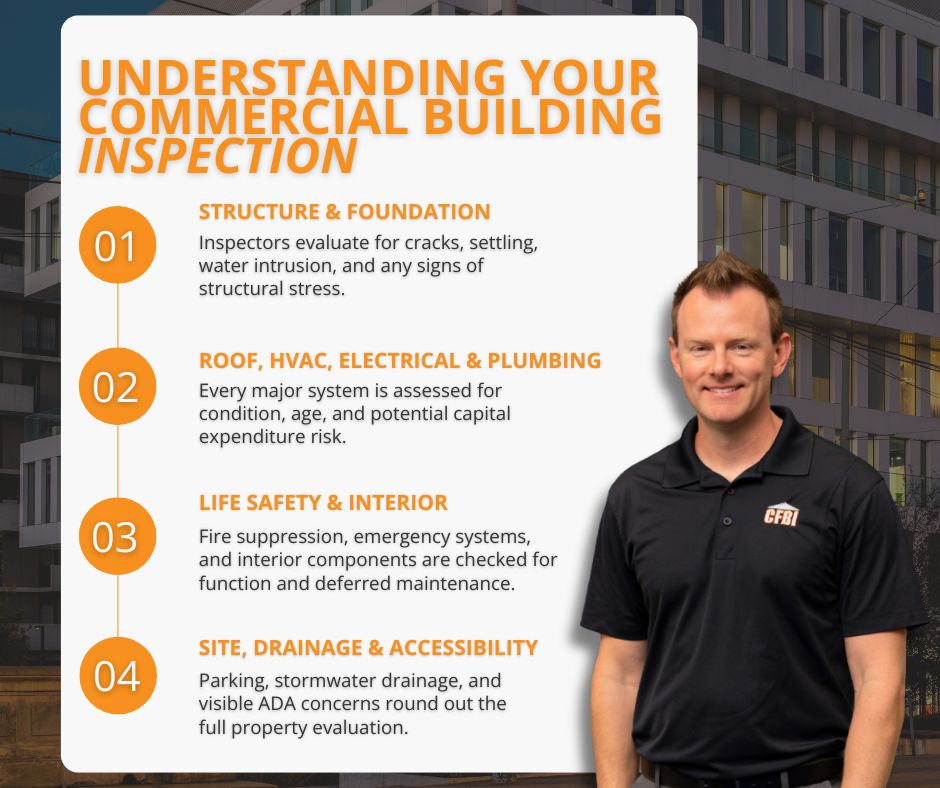
Structural and Foundation
The structural system is evaluated first. Inspectors look for foundation cracks, uneven settling, signs of water intrusion at the base, bowing or bulging walls, and any visible indicators of structural stress.
In Central Florida, sinkhole activity and high water tables are regional factors that get particular attention.
Roof System
The roof is one of the most expensive components to replace on a commercial property and one of the most important to evaluate carefully. Inspectors assess the roofing membrane, drainage systems, penetrations, flashing, and overall condition.
CFBI uses drone technology for roofs that are unsafe or inaccessible to walk, ensuring no area goes unexamined.
Exterior Envelope
This covers the full exterior of the building: walls, windows, doors, caulking, sealants, and any cladding or facade materials. Inspectors look for signs of moisture intrusion, deterioration, poor sealing, and deferred maintenance that could lead to larger problems.
Electrical Systems
Commercial electrical systems are evaluated for code compliance, capacity, panel condition, wiring, grounding, and visible hazards.
Outdated wiring, overloaded panels, and improper installations are common findings in older Central Florida commercial buildings.
Plumbing
Inspectors check supply and drain lines for leaks, corrosion, and proper function. Water pressure is tested, fixtures are operated, and visible pipe conditions are documented.
In Florida’s climate, pipe deterioration from heat and humidity is a consistent issue in buildings that have not had recent plumbing updates.
HVAC Systems
Heating, ventilation, and air conditioning systems are evaluated for condition, age, apparent maintenance history, and operational status. In Central Florida, commercial HVAC systems run hard year-round.
Inspectors check rooftop units, air handlers, ductwork condition, and thermostat function. End-of-life HVAC equipment is one of the most common major capital expenditure findings in commercial reports.
Life Safety Systems
Fire suppression systems, sprinkler heads, alarm panels, emergency lighting, and exit signage are all evaluated during a commercial inspection. These systems are not just a code requirement; they are a liability issue for any buyer or tenant taking on a commercial property.
Interior Components
Walls, ceilings, floors, doors, and interior finishes are inspected for damage, deterioration, moisture staining, and deferred maintenance. Inspectors note cosmetic issues separately from functional or structural concerns so clients can prioritize accordingly.
Parking, Site, and Drainage
The exterior grounds are part of the inspection, too. Parking lot condition, accessible pathways, exterior lighting, landscaping, proximity to the building, and stormwater drainage are all evaluated.
In Florida, drainage issues around commercial properties are a frequent and significant finding given the state’s rainfall patterns and flat terrain.
ADA Accessibility
While CFBI inspectors are not certified ADA compliance specialists, the inspection will flag visible accessibility concerns at entrances, restrooms, ramps, and common areas. These observations can be a useful starting point for a formal ADA compliance review if needed.
How to Prepare for a Commercial Building Inspection
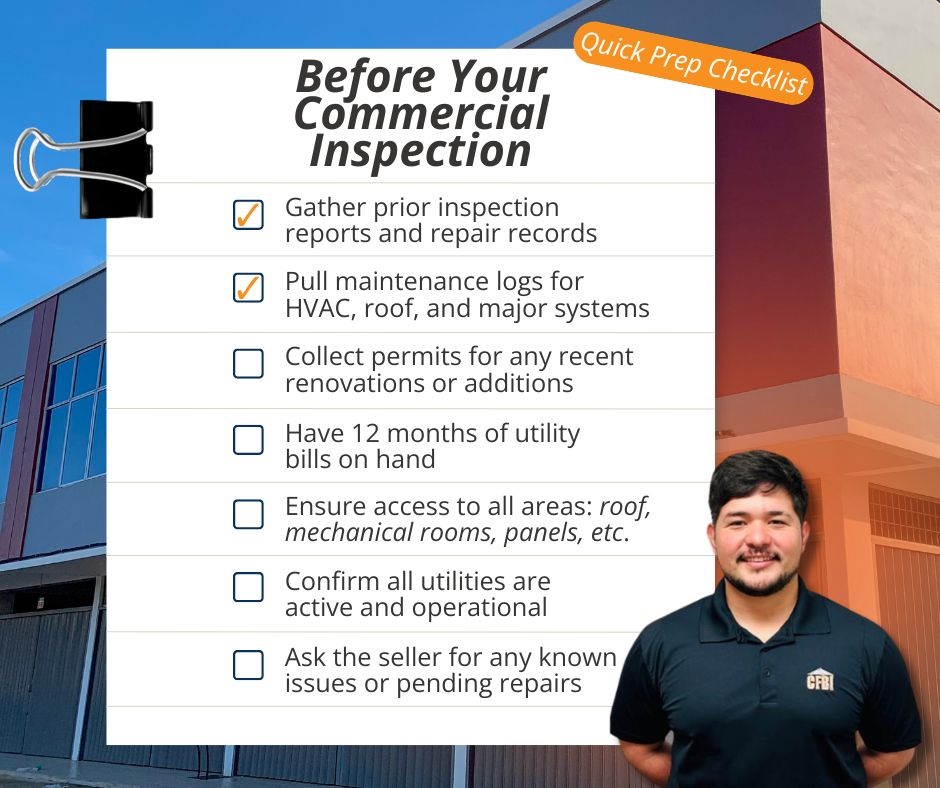
Preparation on your end makes the inspection more efficient and the report more complete. Here is what to have ready before the inspector arrives.
Gather Key Documents
Prior inspection reports or repair records for the property
Maintenance logs for HVAC, roof, elevators, and other major systems
Permits for any recent renovations or additions
Utility bills from the past 12 months (helpful context for HVAC efficiency findings)
Any environmental reports or Phase I/Phase II assessments that have been completed
Existing warranties on roof systems, mechanical equipment, or appliances
Ensure Access to All Areas
This is one of the most important steps. The inspector needs access to every part of the property: the roof, attic spaces, mechanical rooms, electrical panels, crawl spaces, and any locked tenant areas.
Coordinate with current tenants or building managers in advance. Restricted access during an inspection means gaps in the report, and those gaps can create problems later.
Have Utilities Active
All utilities should be on and operational on the day of the inspection. Inspectors need live electricity to test outlets, panels, and lighting. Plumbing needs to be active to check pressure and drainage.
HVAC systems need to be operable to assess function. A property with utilities shut off will result in an incomplete inspection.
Make Mechanical Equipment Accessible
Clear the area around electrical panels, water heaters, HVAC units, and any rooftop access points. Equipment that is blocked or buried behind stored inventory cannot be properly evaluated.
Know the History of the Property
If you are the buyer, ask the seller or listing broker for any known issues, recent repairs, or pending maintenance.
Sellers are not always forthcoming, but disclosed information helps inspectors know where to look more closely and helps you ask better questions after the inspection is complete.
What to Expect from the Report
CFBI provides a detailed written report with photographic documentation of all findings. The report is organized to help clients distinguish between immediate concerns, deferred maintenance items, and items to monitor over time.
For commercial clients, the report also highlights potential major capital expenditures. A roof that has two years of useful life left is a very different financial picture than one that was replaced five years ago, and the report is structured to make those distinctions clear.
Optional add-ons are available depending on the scope of the transaction:
Mold testing: Florida’s humidity and frequent moisture intrusion make mold a relevant concern in many commercial buildings, particularly in older properties or those with known water damage history.
Thermal imaging: Included in every CFBI inspection at no additional cost. Infrared scans help detect hidden moisture, electrical hotspots, and insulation gaps that are not visible to the naked eye.
Drone roof inspection: Also included where applicable. Useful for large flat commercial roofs, multi-story buildings, and any structure where walking on the roof is not safe or practical.
Property Condition Assessment (PCA): A more formal evaluation that follows ASTM E2018 standards, commonly required by lenders, investors, and institutional buyers as part of the due diligence process.
Related Questions
How is a commercial inspection different from a residential one? Commercial inspections are more complex in scope, duration, and required expertise. They cover larger structures, varied building types, specialized systems like fire suppression and commercial HVAC, and often involve code considerations specific to commercial occupancy.
How long does a commercial inspection take? It depends on the size and complexity of the property. Smaller commercial buildings may be completed in a few hours. Larger or multi-building properties can take a full day or longer, with additional time needed for report preparation. CFBI provides a customized scope and timeline with every commercial quote.
What happens if major issues are found? The inspection report gives buyers documented, professional findings to use in negotiations. Options typically include requesting repairs before closing, negotiating a price reduction, asking for a credit at closing, or, in some cases, walking away from the transaction. The report itself is the leverage.
Do commercial properties in Central Florida have region-specific concerns? Yes. Florida’s climate and geography create a consistent set of commercial inspection findings that inspectors in other regions rarely see as frequently.
These include sinkhole risk, high water table effects on foundations and drainage, aggressive HVAC wear from year-round heavy use, accelerated roof membrane deterioration from UV exposure and heat, and elevated humidity driving mold and moisture issues in buildings with any envelope deficiencies.
Conclusion
A commercial building inspection is one of the most important steps in any commercial real estate transaction. It protects buyers from costly surprises, gives investors and tenants a clear picture of what they are taking on, and provides the documentation needed to negotiate from a position of knowledge.
CFBI has provided commercial building inspections across Central Florida since 1988. Our certified inspectors bring commercial-specific training, advanced technology including thermal imaging and drone assessment, and a detailed reporting process designed to give clients exactly what they need to move forward with confidence.
Navigating the world of commercial real estate in Central Florida requires a deep understanding of how different lease structures shift financial responsibility. One of the most common frameworks you will encounter and need to know the meaning of is the triple net lease (NNN).
While this setup can offer stability for landlords, it places a heavy burden on the tenant to maintain the property. Because the tenant is responsible for almost every expense, understanding the triple net lease and the physical state of the building is vital before any papers are signed.
A commercial building in Florida faces intense humidity, sun exposure, and storm risks; all of which can lead to expensive repairs if the building hasn’t been properly maintained. A professional NNN inspection is your primary tool for managing that risk.
Understanding the Meaning of a Triple Net Lease
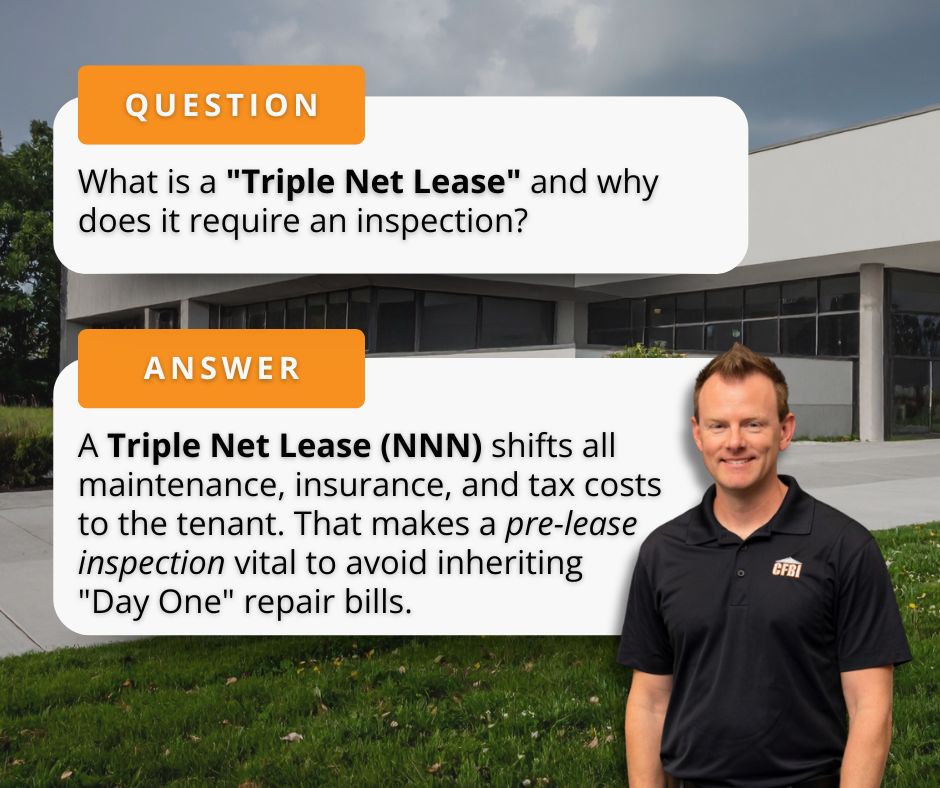
The triple net lease meaning refers to a lease agreement where the tenant pays the base rent plus the three “nets”: property taxes, building insurance, and maintenance costs.
In a standard residential lease, the landlord handles the roof, the HVAC, and the plumbing. In a triple net lease, those responsibilities shift almost entirely to the tenant.
For a business owner, this means you are not just renting space; you are essentially managing the building’s infrastructure. If the air conditioning fails or the parking lot needs repaving, the bill lands on your desk.
This is why a pre-lease inspection is non-negotiable. You need to know exactly what condition those “nets” are in before you agree to pay for their upkeep for the next five to ten years.
The “Three Nets”
Under this agreement, the tenant is responsible for three primary categories of expenses beyond the base rent:
Net Real Estate Taxes: You pay the property taxes for the space you occupy.
Net Property Insurance: You pay the premiums for the building’s insurance coverage.
Net Operating Expenses: This covers all maintenance, repairs, and common area charges.
Why An NNN Inspection Is Critical For Tenants
A commercial inspection for a triple net lease identifies the remaining life of major systems so the tenant can negotiate repair reserves or rent credits.
When you sign an NNN lease, you are often accepting the building in its current condition. If the roof is twenty years old and nearing the end of its life, you could be on the hook for a six-figure replacement just months after moving in.
By hiring CFBI to perform a Property Condition Assessment (PCA), you receive a detailed breakdown of the building’s health. We follow ASTM E2018 standards to ensure every major component is evaluated.
This data allows you to enter negotiations with facts rather than guesses, ensuring the triple net lease meaning does not result in a financial disaster for your business.
Avoiding The “Day One” Expense
Many tenants move in only to find the HVAC units are failing or the electrical system is overloaded. In a triple net lease, even if the unit breaks on day one of your lease, the repair bill is typically yours.
A professional inspection prevents these surprises by giving you an “expiration date” for every major system.
Key Areas Covered In A Commercial Inspection
Our inspectors focus on the “big ticket” items that represent the highest financial risk under a triple net agreement.
We look beyond the cosmetic finishes to the core systems that keep the building operational and safe.
1. Roofing And Building Envelope
In Central Florida, the roof is the first line of defense against tropical storms and intense heat. We inspect for signs of ponding water, membrane degradation, and flashing failures.
A leak in a commercial warehouse or retail space can lead to massive inventory loss and mold issues, both of which are usually the tenant’s responsibility to remediate.
2. HVAC And Mechanical Systems
Commercial HVAC units are expensive to maintain and even more expensive to replace. In Orlando, replacing a standard commercial AC unit in 2026 can cost over $6,000 or more, depending on the tonnage and efficiency.
We evaluate the age, maintenance history, and current performance of the units. In an NNN lease, the tenant is typically responsible for quarterly maintenance and all repairs. If the compressors are failing, you need to know before the lease starts.
3. Electrical And Plumbing Infrastructure
We check for outdated wiring, panel safety, and the condition of the main plumbing lines. For restaurants or medical facilities, these systems are under constant heavy use. Identifying a collapsed sewer line or an overloaded electrical panel during the due diligence period can save you from a forced closure later.
4. Life Safety Systems
This includes fire sprinklers, alarm systems, and emergency lighting. These systems must meet strict local codes in Orange, Osceola, and Seminole counties. If the building is not up to code, the tenant may be required to pay for the upgrades to obtain a certificate of occupancy.
How To Use The Inspection Report In Negotiations
The information found in your CFBI inspection report serves as your primary leverage when finalizing the terms of a triple net lease.
Once you understand the triple net lease meaning and how it applies to your specific building, you can work with your broker to protect your cash flow.
Inspection Finding
Potential Negotiation Strategy
Aging HVAC Units
Request the landlord replace units before move-in.
Roof Near End of Life
Negotiate a “cap” on maintenance costs or a rent credit.
Parking Lot Cracking
Ask for the lot to be resealed and restriped as a condition of the lease.
ADA Compliance Issues
Ensure the landlord brings the exterior into compliance before turnover.
Sewer Line Damage
Require a professional hydro-jetting or repair before signing.
Hidden Costs To Watch For In Triple Net Leases
While the “big three” nets are standard, there are often hidden language and variable costs that can impact your monthly budget.
Being aware of these ensures you aren’t surprised by a bill that exceeds your projections.
Capital Expenditures vs. Maintenance
A major point of contention in NNN leases is the difference between a repair and a replacement. Most leases require the tenant to handle repairs (maintenance), but structural replacements (capital expenditures) may still be the landlord’s responsibility.
Your inspection report clearly labels items that are beyond repair, helping your legal team clarify these boundaries in the contract.
Common Area Maintenance (CAM) Fees
If your business is in a shopping center or multi-tenant building, you will pay CAM fees. These cover parking lot lighting, landscaping, and trash removal.
If the parking lot or driveway is in poor condition, your CAM fees might spike next year to cover the repaving. An inspection of the entire site (not just your unit) is essential for NNN tenants.
Rising Insurance And Tax Costs
Because you pay the taxes and insurance, your “rent” can change every year. In Central Florida, property insurance premiums have fluctuated significantly.
While an inspector doesn’t set these rates, identifying high-risk building features (like an old roof or lack of fire sprinklers) can help you estimate if your insurance costs are likely to rise.
Other Related Questions
What goes into a Property Condition Assessment in Orlando? A Property Condition Assessment (PCA) is a comprehensive deep dive into the physical state of a commercial asset. It follows strict industry standards to evaluate everything from the structural foundation to the life safety systems. This report is often the backbone of the due diligence process for major acquisitions or long-term leases.
How does thermal imaging improve a commercial building inspection? Thermal imaging, or infrared thermography, allows inspectors to “see” temperature differences behind walls and under roof membranes. This technology is vital for spotting hidden moisture intrusion, electrical hotspots, or insulation gaps that the naked eye would miss. It is a non-invasive way to find problems before they lead to structural failure or fire hazards.
Is a sewer scope necessary for commercial buildings? Absolutely. Many commercial buildings in Central Florida have older cast-iron or clay pipes. Since the tenant is often responsible for the plumbing lines all the way to the city connection, a sewer scope is the only way to ensure you aren’t inheriting a collapsed or root-infested pipe.
Does a commercial inspection cover mold and air quality? Standard inspections are primarily structural and mechanical, but we highly recommend adding mold testing in Florida. Because the tenant is responsible for the building’s interior environment, finding a pre-existing mold issue is vital to avoid being blamed for it later.
Wrapping Up
A triple net lease can be a great opportunity for a business to have more control over its space, but it comes with significant financial risk. Understanding the triple net lease meaning is only half the battle; you must also understand the physical reality of the building you are leasing. A professional commercial inspection provides the transparency needed to sign a lease with confidence.
At CFBI, we provide expert commercial building inspections throughout Orlando, Kissimmee, St. Cloud, and the surrounding Central Florida areas. Let us help you uncover the true condition of your property so you can make a smart, informed investment.